Our Legacy
On June 12, 1796, twenty of Philadelphia's intellectual leaders formed the First Unitarian Society of Philadelphia. We were the first continuously functioning church in the country to proclaim itself "Unitarian". The founders were directed and encouraged by the Unitarian minister Joseph Priestley, better known as the father of modern chemistry for his discovery of oxygen. Priestley had fled from England to Pennsylvania after his church, home and laboratory were burned by angry supporters of the Church of England.
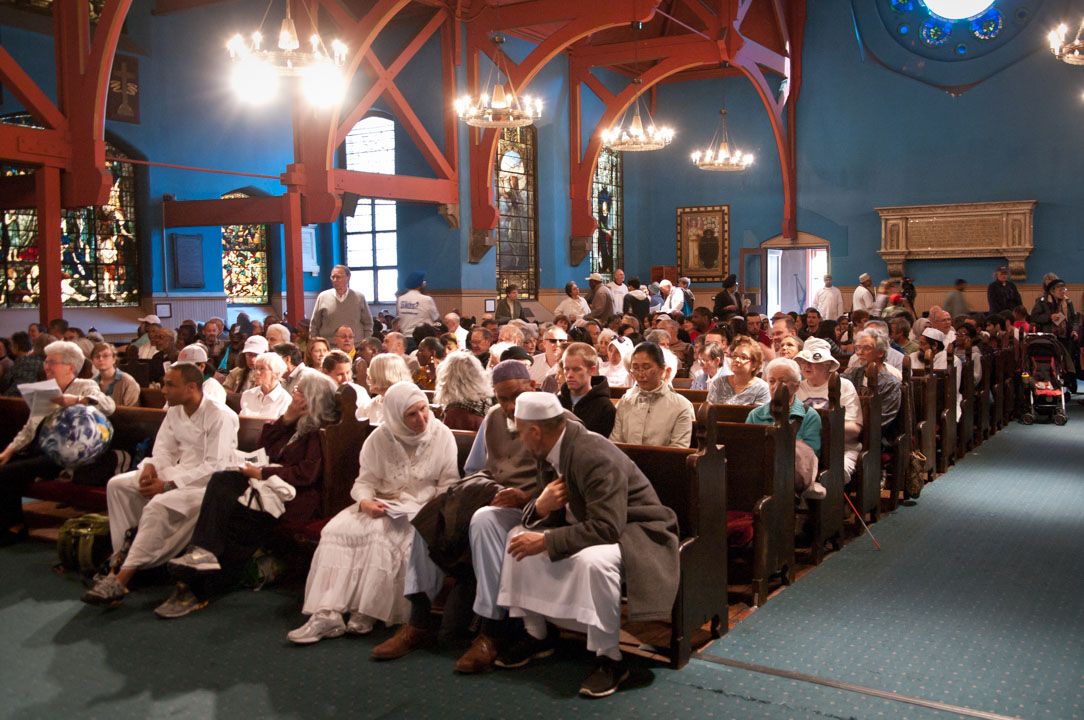
The small but growing congregation was lay-led until 1825, when William Henry Furness was persuaded to serve as our first minister. This young Unitarian minister from Boston ultimately stayed in the role for 50 years. Over time, Rev. Furness became one of the few abolitionist ministers in the city. He counted among his friends such notable figures as Emerson, Thoreau, Whitman, and Bronson Alcott. His son, Frank Furness, was the architect of our current building, the third to serve as our church home.
Some events in our history that define our congregation:
• As noted above, Rev. William Henry Furness served as our minister for 50 years. He is perhaps best remembered for delivering abolitionist sermons prior to the Civil War, at times under the protection of armed members of the congregation. He is also believed to have escorted John Brown's body through Philadelphia under cover of darkness to avoid mobs seeking to desecrate the corpse.
• Frances Ellen Watkins Harper, the first woman of African descent to have her writings published in the United States, was a member of First Church from 1870 until her death in 1911. She is best known for her fiction and poetry, but was also a political activist and lecturer who promoted, civil rights, temperance, and women's rights.
• Rev. Frederick R. Griffin served as our minister for 30 years beginning in 1917. During this time, many of the Church's wealthiest families moved to the suburbs. The resulting decline in donations led Rev. Griffin to abandon the pew rental system and establish the Endowment Fund to provide a basis for financial stability.
• When Martin Luther King Jr. was a seminary student in nearby Chester, he attended a lecture about Gandhi that inspired his later non-violent protests for civil rights. This lecture is reputed to have taken place in our sanctuary.
• Beginning in 1968, Rev. Victor H. Carpenter led our congregation into social activism on issues such as prison reform, civil rights, black empowerment, woman's liberation and especially the peace movement. Long-time members recall candle vigils on our main entrance porch to protest the Vietnam War.
• The. Rev. Beth Ide was installed as Assistant Minister in 1975. She was the first woman to serve our congregation in a ministerial role.
• In 2007, Rev. Nate Walker became the first openly gay minister the year after we officially became a Welcoming Congregation.
Previous page: Our Minister
Next page: Ministerial History